Servo-Controlled Variac with Isolating Transformer: A Structured Approach to Power Conditioning
Introduction
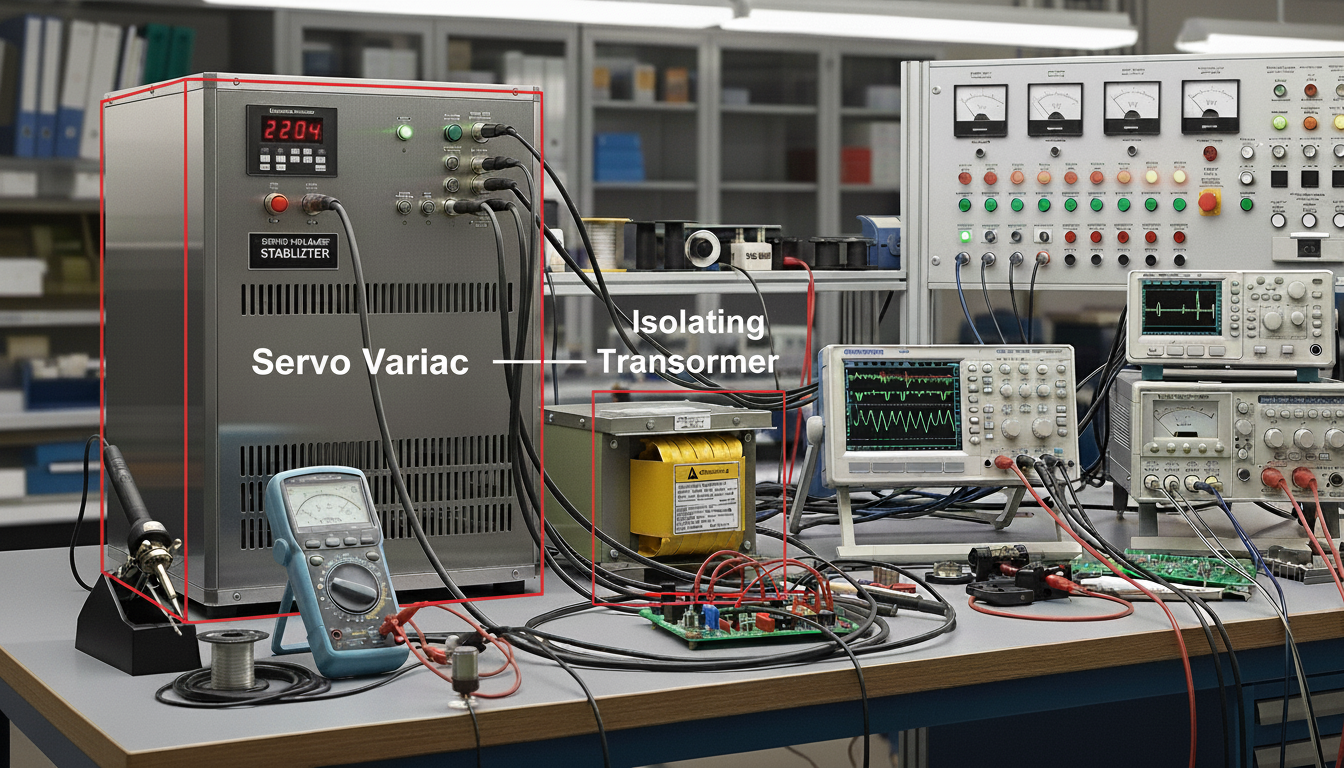
In many practical electrical systems—particularly in laboratories, testing facilities, and industrial environments—power quality is a critical concern. Voltage fluctuations, electrical noise, and grounding issues can adversely affect sensitive equipment. This is especially relevant in regions like India, where grid variations are not uncommon. A robust and widely adopted solution is the integration of a servo-controlled variac (servo voltage stabiliser) followed by an isolating transformer after the main power supply (Fig.1). This combination ensures both voltage stability and electrical isolation, significantly improving system reliability and safety (Fig.2).
Fig.1 Industrial Laboratory Setup with Servo Voltage Stabiliser and Isolating Transformer Supplying Precision Equipment
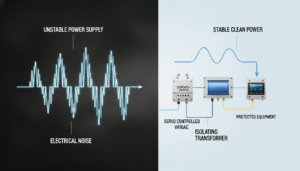
Fig.2 Unstable Power Supply and Stabilised Output Using Servo-Controlled Variac and Isolating Transformer
Servo-Controlled Variac: Working Principle
A servo-controlled variac (Fig.3) is an automatic voltage regulator based on a closed-loop control system. Its operation involves:
- Voltage Sensing: Continuously monitors input voltage.
- Error Detection: Compares input voltage with a preset reference.
- Correction Mechanism: A servo motor adjusts the brush position on an autotransformer.
- Output Regulation: Maintains nearly constant output voltage (typically within ±1%).
Key Features:
- High accuracy and fast response
- Continuous and smooth voltage correction
- Suitable for both under-voltage and over-voltage conditions
According to Electrical Power Systems, voltage regulation is essential for maintaining system efficiency and preventing damage to electrical loads, particularly in fluctuating supply conditions.
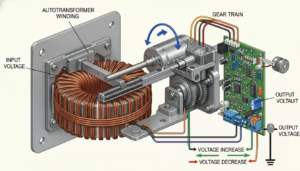
Fig.3 Servo-Controlled Variac
Isolating Transformer: Function and Importance
An isolating transformer provides galvanic isolation between input and output circuits. This means there is no direct electrical connection between primary and secondary windings.
Key Functions:
- Electrical Isolation: Prevents direct conduction of faults
- Noise Reduction: Minimises common-mode noise
- Safety Enhancement: Protects users from electric shock
- Ground Loop Elimination: Avoids unwanted current paths
As discussed in The Art of Electronics, isolation is crucial in sensitive electronic systems to maintain signal integrity and reduce interference.
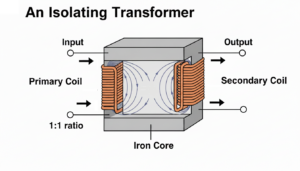
Fig.4 Isolating Transformer
Combined System Architecture
Configuration Flow:
Main Supply → Servo-Controlled Variac → Isolating Transformer → Load
Functional Advantages:
- The servo stabiliser ensures voltage consistency
- The isolating transformer ensures safety and noise-free supply
- Together, they provide a clean, stable, and protected power source
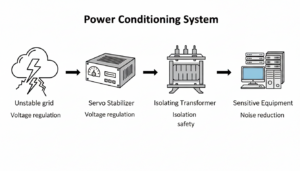
Fig.5 Power Conditioning System
Technical Benefits
|
Aspect |
Contribution |
|
Voltage Stability |
Maintains constant output despite input variation |
|
Equipment Protection |
Prevents damage due to voltage spikes/dips |
|
Electrical Safety |
Isolates load from supply faults |
|
Noise Suppression |
Reduces EMI and harmonics |
|
Reliability |
Ensures consistent system performance |
Applications
This combined setup is widely used in the following domains:
a) Laboratory and Research Systems
- High-voltage testing setups
- Precision measurement instruments
- Calibration equipmen
b) Medical Equipment
- MRI and CT scan systems
- ICU monitoring devices
- Diagnostic instruments
c) Industrial Applications
- CNC machines
- Semiconductor fabrication units
- Automation and control systems
d) IT and Communication
- Data centres
- Server rooms
- Telecommunication systems
e) Educational Institutions
- Engineering laboratories
- Power electronics experiments
Practical Considerations
When implementing this system, the following factors should be considered:
- Proper rating selection (kVA capacity)
- Adequate cooling and ventilation
- Regular maintenance of servo mechanism
- Proper earthing and grounding practices
- Compliance with standards such as those recommended by Institute of Electrical and Electronics Engineers
Conclusion
The integration of a servo-controlled variac with an isolating transformer provides a comprehensive solution to power quality challenges. While the servo stabiliser effectively mitigates voltage fluctuations, the isolating transformer ensures electrical safety and noise reduction. This dual-stage approach is essential for protecting sensitive equipment, improving operational reliability, and maintaining high-quality power delivery in critical applications.